
Start from honest benchmarks
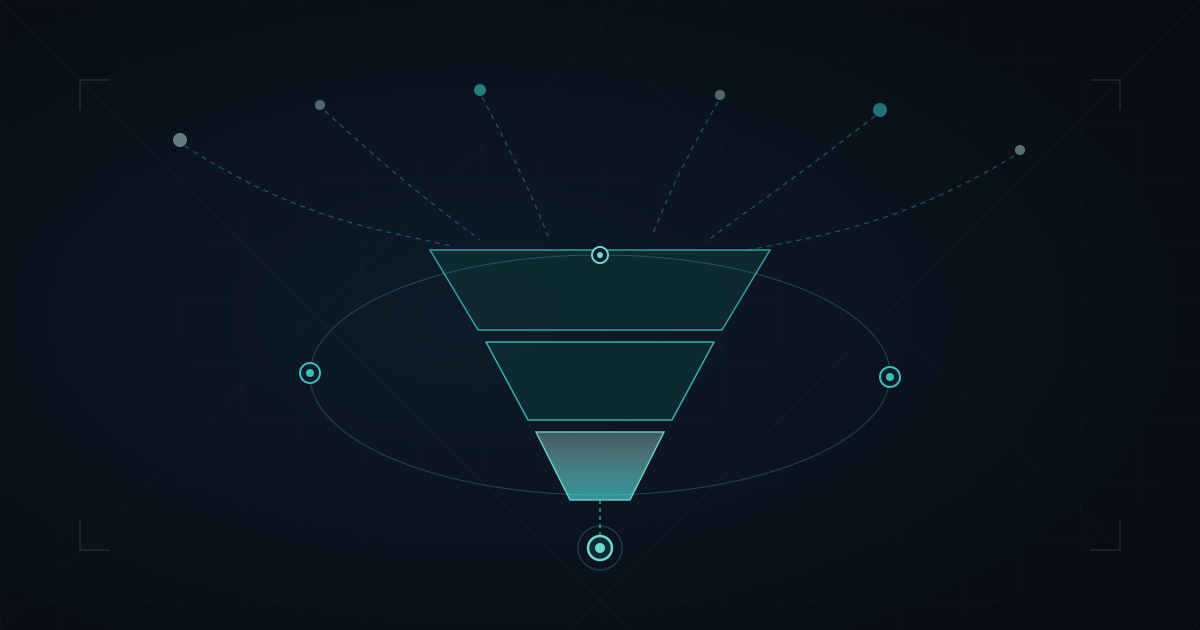
Most CRO conversations start with someone quoting an industry average conversion rate that nobody can trace. Here are numbers with names attached. First Page Sage, aggregating a decade of data from more than 50 B2B SaaS companies, puts the typical funnel at roughly 1.5% visitor to lead, 40% lead to MQL, 39% MQL to SQL, 41% SQL to opportunity and 37% opportunity to close.
Unbounce's Conversion Benchmark Report, built on 57 million conversions across 41,000 landing pages, finds the median SaaS landing page converts at 3.8%, well below the 6.6% cross industry baseline, while the top quartile clears 11.6%. The spread between median and top quartile is the entire CRO opportunity, and the honest caveat is that these datasets measure different things. Treat every benchmark as a range to locate yourself in, never a target to copy.
Channel mix quietly decides your conversion rate
Before touching a headline, look at where your traffic comes from, because source explains more variance than design. In First Page Sage's channel data, SEO traffic converts visitor to lead at 2.1% and LinkedIn at 2.2%, while paid search manages 0.7%, and the gap widens downstream: SEO leads become SQLs at 51% versus 26% for PPC. Unbounce finds email traffic converting landing pages at a median of 16.9%, more than four times any other source.
A team that shifts budget toward the sources that compound, then optimizes the pages those visitors land on, will beat a team that A/B tests button colors on cold paid traffic every time.
3.8%
median SaaS landing page conversion; the top 25% convert above 11.6% (Unbounce, 57M conversions)
12.9%
conversion of pages written at accessible reading level, vs 2.1% for dense professional copy (Unbounce)
48.8%
trial to paid conversion when a card is required, vs 18.2% without (First Page Sage)
67%
of B2B buyers prefer a rep free buying experience (Gartner, 2026)
The evidence on what moves B2B conversion
The strongest quantified finding in recent CRO research is about copy, not layout: Unbounce's analysis found pages written at an accessible reading level converted at 12.9% versus 2.1% for pages written in dense professional prose, a six fold difference, with ideal length between 250 and 725 words. Speed matters directionally: the Deloitte and Google study of 37 brand sites found a 0.1 second mobile improvement lifted conversions 8 to 10% in retail and travel, though no equivalent B2B SaaS study exists.
Form evidence is contradictory and stage dependent: published studies show cases where cutting fields reduced conversions and multi step forms lifted completions dramatically, so the rule is short forms for cold offers, longer or multi step for high intent requests like demos. And on social proof, honesty requires saying the quantitative evidence in B2B is thin; the circulating percentages are aggregator folklore. Use real customer logos and specific outcomes because qualitative research consistently supports them, not because a fake statistic told you to.
Trial, demo or both: Pick with data
The most consequential conversion decision in SaaS is not on a landing page, it is the offer itself. First Page Sage's benchmarks quantify the tradeoff: trials that require a credit card convert to paid at 48.8% versus 18.2% for open trials, but card walls suppress signups at the top. OpenView's product led growth benchmarks found freemium converts visitors to signups at roughly twice the rate of trials, around 6% versus 3 to 4%, while trials convert signups to paid at triple the rate of freemium, 17% versus 5%.
Meanwhile Gartner reports 67% of B2B buyers now prefer a rep free experience, and also warns that fully rep free purchases correlate with higher buyer regret. The synthesis: offer a self serve path for the majority who want it, keep a demo path for complex deals, and choose your trial friction based on whether your bottleneck is volume or quality.
The low traffic reality check
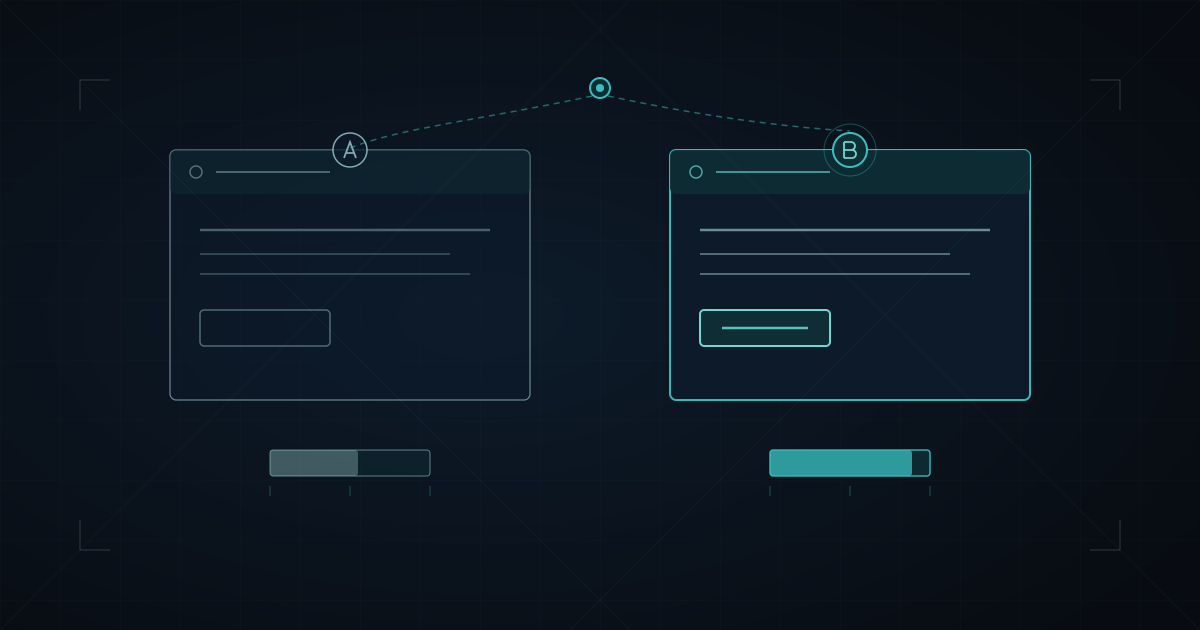
CXL's worked example: a page with 100 visitors a day converting at 2% needs close to a year to reach statistical significance on a typical A/B test. Most B2B SaaS sites are in that traffic class, which means most of their A/B tests are theater. Below roughly 1,000 conversions a month per tested page, your experimentation program should be built on user research, session recordings, form analytics and bold sequential redesigns, not split tests of small changes.
The loop that works at B2B traffic levels
- Research first: watch session recordings, run five user interviews, read sales call notes, mine form analytics
- Fix the obvious before testing anything: broken flows, unclear pricing, jargon, slow mobile pages
- Make big bets, not tweaks: radical page redesigns produce effects large enough to detect on modest traffic
- Use painted door tests to validate demand for offers and features before building them
- Reserve A/B testing for your few high traffic pages, with sample size and duration fixed before launch
- Close the loop in the CRM: judge experiments on pipeline created, not click rate
The statistics that keep you honest
Two failure modes produce most fake CRO wins. The first is peeking: checking results daily and stopping the moment significance appears inflates real false positive rates to 20 or 30%, per analyses from experimentation platforms Statsig and Eppo. The fix is deciding sample size and duration up front, or using a proper sequential testing framework that allows continuous monitoring at the cost of somewhat larger samples.
The second is the miracle win: trustworthy tests usually move metrics by single digit percentages, so a 60% lift on a small sample is far more likely to be noise than genius. Standard conventions, 95% confidence and 80% power, exist to protect you from shipping randomness. The minimum detectable effect calculation matters more than any of them: halving the effect you want to detect quadruples the sample you need, which is exactly why small sites should hunt big effects.
Where AI actually helps CRO in 2026
AI entered the CRO toolchain, and its real value is upstream of the test. Tools like Optimizely's experiment advisor and VWO's copilot now generate hypotheses, draft variants and, most usefully, analyze session recordings and heatmaps automatically, compressing weeks of qualitative research into days. What AI does not change is the arithmetic of sample size or the need for judgment about what is worth testing. The practitioner consensus is clear: AI compresses research and ideation; humans still decide what matters.
One regulatory note for teams personalizing with AI on personal data: the EU AI Act's high risk obligations land in August 2026, bringing auditability requirements that growth teams operating in Europe should design for now.
Below a thousand conversions a month, most A/B tests are theater. Research finds the answer faster than the test can.

Written by
Vicente Pavez
Head of Growth Product
Commercial engineer from Universidad de Chile (Summa Cum Laude). Growth marketing and product operations specialist with experience at BairesDev. Results-driven, he leads how the studio applies AI across its growth work.