
The click is no longer the default outcome
The most important number in search today comes from SparkToro's June 2026 analysis of Similarweb clickstream data: 68% of US Google searches now end without a single click, up from 60% in 2024. Google answers more and more queries on its own results page, through AI Overviews, featured snippets and knowledge panels.
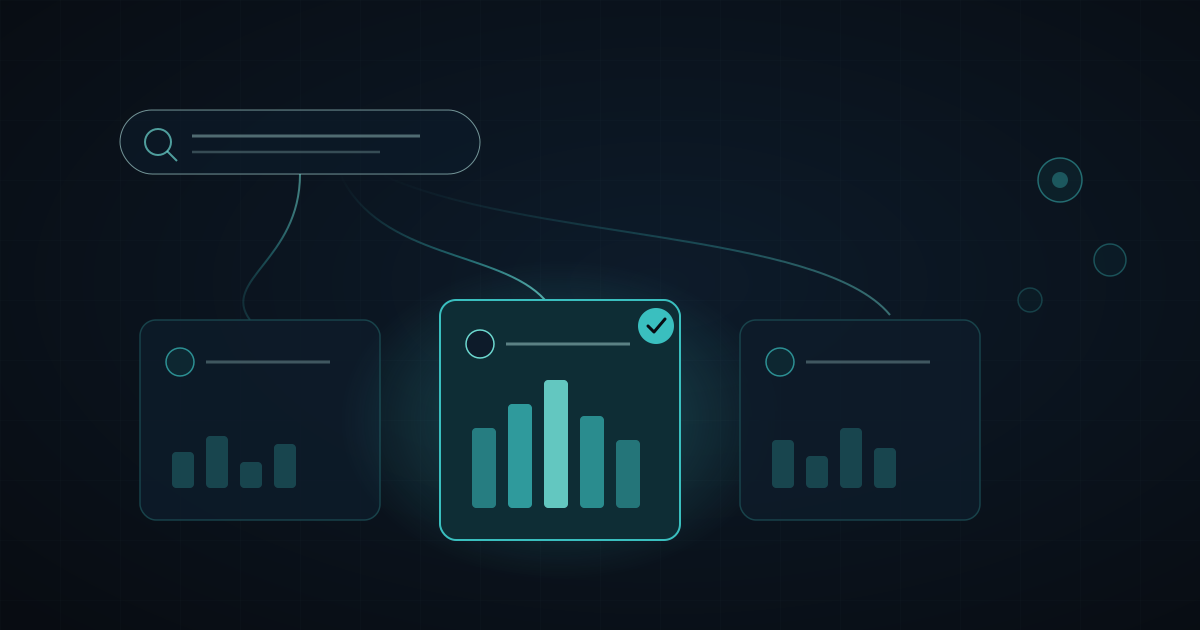
Add the assistants people consult instead of Google, and a growing share of your market never visits any website while forming an opinion about you. Answer Engine Optimization, AEO, is the response: optimizing to be the answer these systems give, not just a link they list.
AEO in plain terms
AEO is the work of getting selected as the answer by systems that answer directly: Google AI Overviews and AI Mode, featured snippets, ChatGPT, Perplexity, Copilot and voice assistants. It overlaps so much with GEO (Generative Engine Optimization, focused on LLM citations) that leading practitioners treat them as one discipline, and Google's own optimization guide, updated July 2026, insists both are still fundamentally SEO.
That framing is honest: AEO is not a replacement for SEO. It is a shift in the target outcome, from earning the ranked click to being the cited answer, built on the same technical foundation.
68%
of US Google searches end without a click, up from 60% in 2024 (SparkToro, June 2026)
-34.5%
CTR on position 1 when an AI Overview appears (Ahrefs, 300,000 keywords, 2025)
94%
of AI Overviews cite at least one top 20 organic result (seoClarity, 362,000 queries, 2025)
0.664
correlation of brand mentions with AI visibility, versus 0.218 for backlinks (Ahrefs, 75,000 brands)
The cost of ignoring it, measured
Ahrefs studied 300,000 keywords and found that when an AI Overview appears, the click rate on the first organic position drops 34.5%. Seer Interactive's ongoing tracker across 42 organizations found organic CTR on queries with an AI Overview fell to 0.52% when the brand was not cited, versus 1.45% on queries without one.
Pew Research Center measured real user behavior across 68,879 searches and found people clicked a traditional result in only 8% of visits when an AI summary appeared, versus 15% without. Google disputes these methodologies but has not published contradicting data. The pattern across every independent dataset is the same: informational queries increasingly resolve on the results page.
What stays the same
Here is the part the AEO hype industry skips: the fundamentals did not change. Google states plainly in its generative AI guide that AI Overviews and AI Mode are rooted in its core ranking and quality systems, and that no special optimization exists for them.
The data backs this up. seoClarity analyzed 362,000 US queries in October 2025 and found 94% of AI Overviews cite at least one result from the organic top 20, and pages ranking first get included 43% of the time versus 7% for position 20.
Crawlability, indexation, site speed, expertise signals and genuinely helpful content still gate everything, because answer engines select from search indexes. If your SEO foundation is weak, there is nothing for the answer engine to select.
What actually changes
The real changes are concrete and mostly editorial. First, structure: answer engines cite passages, not pages, so each important section needs a question shaped heading followed by a direct, self contained answer of two to four sentences before the nuance.
Second, coverage: Google decomposes queries into sub questions through what it calls query fan out, which rewards pages that thoroughly answer adjacent questions rather than repeating one keyword. Third, evidence: the Princeton GEO study (KDD 2024) found that adding statistics, quotations and cited sources lifted visibility in generated answers by 30% to 41%, while keyword stuffing hurt it.
Fourth, and least intuitive: your presence outside your own site now matters as much as your content. Pew found Wikipedia, YouTube and Reddit among the most cited sources in AI Overviews, and Ahrefs found brand mentions across the web correlate three times more strongly with AI visibility than backlinks do.
What Google explicitly says not to bother with
Google's July 2026 guide debunks three popular AEO tactics by name: llms.txt files (they neither help nor harm), chopping content into fragments for machines, and rewriting pages specifically for AI. Structured data helps machines understand your entities and is confirmed useful for Bing's AI systems, but Google states it is not required for generative features. Treat schema as hygiene, not as a citation lever.
The commercial query shift nobody planned for
The comforting theory of 2024 was that AI Overviews would only absorb informational queries while commercial searches stayed safely clickable. That theory expired. Semrush tracked more than ten million keywords through 2025 and watched AI Overview coverage of commercial queries grow from 8% in January to 19% by November, with transactional queries rising from 2% to 14%.
Answer engines are moving down the funnel, into comparison and purchase intent territory. The queries that generate pipeline are exactly the ones where being the cited recommendation, rather than result number four, will matter most.
The AEO checklist that survives scrutiny
- Keep the SEO foundation strong: crawlable, indexed, fast, with real expertise behind the content
- Give every key page an answer first structure: question heading, direct answer, then depth
- Add citable evidence: named statistics, expert quotes and sources, the tactics with measured impact
- Cover question clusters completely instead of optimizing one keyword per page
- Build brand presence on the platforms engines cite: Reddit, YouTube, Wikipedia, review sites and trade media
- Track your share of answers monthly across Google AI features, ChatGPT and Perplexity, not just rankings
How to think about measurement now
If clicks are structurally declining on answered queries, judging your program purely on sessions guarantees disappointment. The emerging practice is to measure three layers.
Visibility: how often you are cited across the answer surfaces your buyers use, tracked with a fixed set of buyer questions or tools built for the job. Demand: branded search volume and direct traffic, which capture people who saw the answer and came looking for you.
And revenue quality: Seer Interactive's data shows being cited in an AI Overview roughly doubles the clicks you capture per impression compared with being absent, and the small stream of AI referred visitors converts well above organic averages in multiple datasets. Fewer visits, better visits, and a brand that gets recommended when nobody clicks at all: that is the scoreboard AEO plays on.
AEO is not a replacement for SEO. It is the same foundation with a new target outcome: being the answer instead of the fourth link.

Written by
Vicente Pavez
Head of Growth Product
Commercial engineer from Universidad de Chile (Summa Cum Laude). Growth marketing and product operations specialist with experience at BairesDev. Results-driven, he leads how the studio applies AI across its growth work.